卡珊德拉
卡珊德拉:普里阿摩斯国王之女
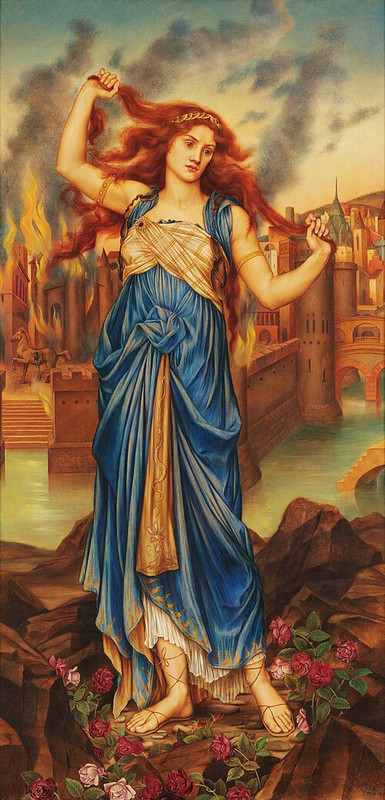
Cassandra - Evelyn de Morgan (1855-1919)
卡珊德拉是特洛伊城的凡人公主,她是特洛伊国王普里阿摩斯(Priam)与王后赫卡柏(Hecabe / Hecuba)的女儿。卡珊德拉有许多兄弟姐妹,据说普里阿摩斯育有一百个子女,其中最著名的包括赫克托耳(Hector)、帕里斯(Paris),以及卡珊德拉的孪生兄弟海伦诺斯(Helenus)。
卡珊德拉也被称为“亚历山德拉”(Alexandra),就像帕里斯有时也被称为“亚历山大”(Alexander)。
卡珊德拉与阿波罗
卡珊德拉长大后成为普里阿摩斯所有女儿中最美丽的一位,因此她有许多潜在的追求者,包括凡人与神祇。
众所周知,宙斯经常关注美貌的凡人女子,但在卡珊德拉的故事中,真正追求她的是宙斯的儿子阿波罗。在最广为流传的版本中,正是阿波罗赋予了卡珊德拉预见未来的能力。
在这个版本的故事里,阿波罗因卡珊德拉的美貌而倾心,试图诱惑这位凡人公主。为了打动卡珊德拉,阿波罗提出赠予她预言的能力,卡珊德拉欣然接受了这份礼物。然而,在接受预言能力之后,卡珊德拉却拒绝了阿波罗的性追求。
被拒绝的阿波罗本可以直接收回卡珊德拉的新能力,但他选择以报复的方式惩罚这位拒绝他的女子。
因此,从那天起,卡珊德拉的预言将永远成真,但没有人会相信她的任何预言。
卡珊德拉与海伦诺斯
随后,卡珊德拉将她的预言能力教授给她的孪生兄弟海伦诺斯,而卡珊德拉作为导师极为出色,以至于海伦诺斯的预言也总是应验。当然,与卡珊德拉不同的是,人们相信海伦诺斯的预言。
卡珊德拉获得预言能力
另一个版本的神话则讲述兄妹二人同时获得预言能力:当他们还是婴儿时,卡珊德拉和海伦诺斯被留在阿波罗的神庙中过夜。夜间,两条蛇从黑暗的角落中爬出,来到普里阿摩斯的两个孩子身边。蛇舔净了卡珊德拉和海伦诺斯的耳朵,使他们能够清晰地听到自然的声音,从而能够准确地占卜未来。
后来,卡珊德拉拒绝了阿波罗的追求,于是与第一个版本相同,阿波罗诅咒了这位特洛伊公主,使她的预言无人相信。
卡珊德拉的追求者
凡人也同样被卡珊德拉拒绝。据说赫拉克勒斯之子特勒福斯(Telephus)曾被卡珊德拉拒绝,不过在特勒福斯的故事中,卡珊德拉确实帮助这位未来的密西亚国王娶了她的妹妹拉俄狄刻(Laodice,或称阿斯提俄刻 Astyoche)。
后来,卡珊德拉的其他追求者还包括卡贝乌斯的奥特律俄纽斯(Othryoneus)以及弗里吉亚的科罗厄布斯(Coroebus)。
卡珊德拉的预言
卡珊德拉在希腊神话中之所以重要,是因为她在特洛伊相关事件中的角色。
一些古代文献记载,卡珊德拉在帕里斯出生时便预言特洛伊将被毁灭,并说她的新生弟弟应当被处死。然而她的预言只有在她的异母兄弟埃萨科斯(Aesacus)说出同样的话时才被采纳。这个故事通常只归于埃萨科斯。
卡珊德拉最常被提及的预言之一再次与帕里斯有关,但发生在多年之后:帕里斯带着墨涅拉俄斯的妻子海伦回到特洛伊。赫克托耳斥责弟弟的行为,而卡珊德拉则预见了特洛伊未来的毁灭。然而,按照阿波罗的诅咒,她的警告再次被忽视。
海伦的劫持当然导致了特洛伊战争。在战争期间,卡珊德拉目睹了许多兄弟为保卫特洛伊而死。最终,阿开亚人设计了攻陷特洛伊的计划,制造了一匹木马,并将其看似遗弃在城墙外。
卡珊德拉立刻看出,如果特洛伊人将木马带入城中会发生什么。她竭力劝告族人,但当然被忽视。于是,木马腹中满载阿开亚英雄,被拖入特洛伊,导致当夜特洛伊城被洗劫。
卡珊德拉的遭遇
当希腊英雄占领特洛伊时,卡珊德拉在城中心的雅典娜神庙中寻求庇护。然而神庙并未成为避难所,就像宙斯神庙未能保护普里阿摩斯和波利忒斯一样。卡珊德拉在神庙中被小埃阿斯(Ajax the Lesser)发现,并遭到这位洛克里斯英雄的强暴。
这是希腊英雄们犯下的亵渎行为之一,因此许多希腊英雄在战后返乡时经历了漫长而危险的旅程。
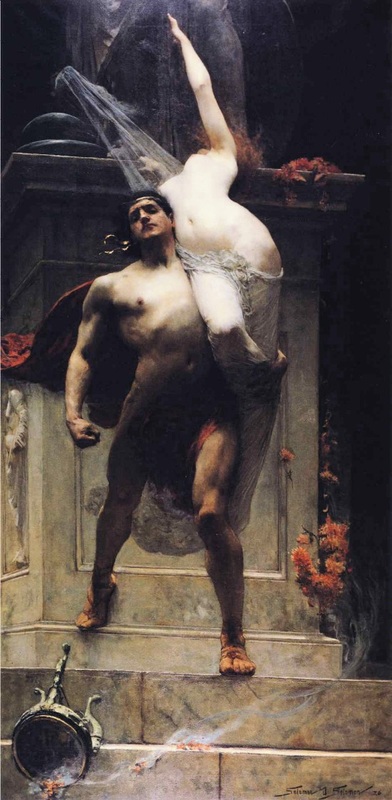
Ajax and Cassandra - Solomon Joseph Solomon (1860-1927)
卡珊德拉之死
随着特洛伊的陷落,卡珊德拉成为战利品。希腊军队的统帅阿伽门农获得了他应得的份额,卡珊德拉成为迈锡尼国王的妾。卡珊德拉甚至为阿伽门农生下了一对双胞胎儿子:皮洛普斯(Pelops)和特勒达摩斯(Teledamus)。
尽管身为阿伽门农的奴隶,卡珊德拉仍试图警告国王他们返回迈锡尼后将面临的命运;她知道他们会被杀害,因为阿伽门农的妻子克吕泰涅斯特拉(Clytemnestra)正与埃癸斯托斯(Aegisthus)私通。
如同卡珊德拉所有的预言,这一警告被忽视。阿伽门农在幸存特洛伊战争后最终被杀。埃癸斯托斯也杀死了卡珊德拉以及她为阿伽门农所生的两个儿子。
卡珊德拉的幸存版本
在较少流传的版本中,《特洛伊陷落史》(Dares of Phrygia)记载卡珊德拉并未随阿伽门农返回家乡。迈锡尼国王在战后给予卡珊德拉、她的兄弟海伦诺斯、她的母亲赫卡柏,以及她的嫂子安德洛玛刻(Andromache)自由。这四位前特洛伊人随后在色雷斯的凯尔索涅斯(即今日加里波利半岛)建立了新的家园。
Cassandra Daughter of King Priam
Cassandra was a mortal princess of the city of Troy, for Cassandra was the daughter of King Priam of Troy, and his wife Hecabe (Hecuba). Cassandra would have many siblings, for some said that Priam fathered 100 children, but amongst the most notable were Hector and Paris, and also Cassandra’s twin brother Helenus.
Cassandra was also known as Alexandra, in a similar way to how Paris is sometimes referred to as Alexander.
Cassandra and Apollo
Cassandra would grow up to become the most beautiful of all of King Priam’s daughters and as a result she had many potential suitors, both mortal and immortal.
Zeus was of course well known for keeping an eye out for beautiful mortals, but in the case of Cassandra it was actually his son Apollo who vied for the daughter of Priam; and in the most common version of the Cassandra myth, it is Apollo who enables Cassandra to see into the future.
In this version of the story, Apollo, smitten with the beauty of Cassandra, attempts to seduce the mortal princess. To help sway Cassandra, Apollo offers up the gift of prophecy, a gift which Cassandra willingly accepts. Having accepted the gift though, Cassandra then rebuts the sexual advances of Apollo.
A spurned Apollo could have simply taken Cassandra’s new ability away from her, but in an act of vengeance, Apollo instead decides to curse the woman who spurned him.
Thus, from that day on, Cassandra’s prophecies would always come to pass, but no one would ever believe her predictions.
Subsequently, Cassandra would then teach her twin brother Helenus how to see in the future, and so good was Cassandra as a tutor that Helenus’ predictions would also always come true, although of course, Helenus’ would be believed.
Cassandra Gains Her Powers
An alternative version of the Cassandra myth has brother and sister receiving their prophetic abilities at the same time; for when still babes, Cassandra and Helenus were left overnight in the temple of Apollo. During the night, two serpents emerged from the dark recesses, and made their way to the two children of King Priam. The serpents then licked clean the ears of Cassandra and Helenus, allowing both to hear clearly the sounds of nature, allowing accurate divination of the future.
Later on, Cassandra would spurn the advances of Apollo, and in the same way as the first version of the Cassandra myth, Apollo would curse the Trojan princess so that her predictions were ignored.
The Suitors of Cassandra
Mortals though were also spurned by Cassandra, and some say how Telephus, a son of Heracles was rejected by Cassandra, although in the case of Telephus, Cassandra did help the future king of Mysia wed her sister Laodice (or Astyoche).
Later, other suitors of Cassandra were said to include Othryoneus of Cabeus and Coroebus of Phrygia.
The Predictions of Cassandra
Cassandra comes to prominence in Greek mythology because of events at Troy.
Some ancient sources tell of how Cassandra predicted the destruction of Troy when Paris was born to Hecabe, and told how her new-born brother should be put to death, the prophecy though was only listened to when Cassandra’s half-brother, Aesacus said the same thing. This story is normally ascribed to Aesacus alone.
Cassandra’s first commonly told prediction again involves Paris, but from years later, when her brother returns to Troy with Helen, wife of Menelaus in tow. Hector would chastise his brother for his actions, but Cassandra told how she now saw the future ruin of Troy, but of course, as per the curse of Apollo, Cassandra was ignored.
The abduction of Helen would of course lead to the Trojan War, and during the war Cassandra would witness many of her brothers die in defence of Troy. Eventually, the Achaeans came up with a plan to finally take the city of Troy, and a Wooden Horse was constructed, and then seemingly abandoned outside the city walls.
Cassandra immediately saw what would happen if the Trojans were to take possession of the horse, and whilst Cassandra tried to convince her kinsmen of the risk, she was of course ignored. Thus, the Wooden Horse, with its belly full of Achaean heroes, was taken into Troy, leading, that night, to the Sacking of Troy.
The Rape of Cassandra
As the Greek heroes took possession of Troy, Cassandra would seek sanctuary within the Temple of Athena, in the heart of the city. The temple though proved to be no refuge, just as the Temple of Zeus proved no sanctuary for Priam and Polites. Cassandra was found in the temple by Ajax the Lesser, and there the daughter of King Priam was raped by Locrian Ajax.
This was one of the acts of sacrilege which would see many of the Greek heroes endure long and perilous journeys home after the war.
The Death of Cassandra
With the fall of Troy, Cassandra became a prize of war, and Agamemnon, as commander of the Greek forces, received his fair share of the spoils, and Cassandra became a concubine of the King of Mycenae. Indeed, Cassandra would give birth to twin sons for Agamemnon, Pelops and Teledamus.
Despite being a slave of Agamemnon, Cassandra still attempted to warn the king of his, and her own fate if they were to return to Mycenae; for Cassandra knew that they would be murdered, for Agamemnon’s wife, Clytemnestra was having an affair with Aegisthus.
As with all of Cassandra’s predictions this was ignored, and so Agamemnon did indeed die after surviving the Trojan War. Aegisthus would also kill Cassandra, and the two sons she had born to Agamemnon.
Cassandra Survives
A less common tale told in History of the Fall of Troy (Dares of Phrygia) sees Cassandra not in the company of Agamemnon when he returned home, for the King Of Mycenae had given Cassandra, her brother Helenus, her mother Hecabe, and her sister-in-law Andromache, their freedom after the war. These four former Trojans would make a new home for themselves in Thracian Chersonese (Gallipoli peninsula).